Comptroller vs. Controller: What’s the Difference and Why Should You Care?
These top accounting experts have significant influence in the private and public sectors. To rise in the business world, you must know how to equip them for success.
Finances are the foundation of any organization. Your company must keep a close eye on transactions, or you won’t be able to manage your budget, handle payroll, or achieve business goals. That’s why comptrollers and controllers exist.
These two positions oversee finances for companies and organizations, sharing many of the same duties. This quick guide compares the comptroller vs. controller roles, explaining the subtle differences that characterize these jobs and their challenges.
It also discusses how a NetSuite Enterprise Resource Planning (ERP) system can help comptrollers and controllers overcome obstacles with handy features like automated processes and real-time data updates.
SuiteDynamics is a NetSuite Alliance Partner, meaning we work with NetSuite to customize and implement these ERP systems. We understand how overwhelming new software can be, with complex features and steep learning curves that can distract your staff from productivity. Our experts build simple, intuitive solutions and offer custom training programs so your team can navigate NetSuite in no time.
Schedule a free consultation to learn more about NetSuite’s financial management tools and discover how well your business can run.
Comptroller vs Controller: What's the Difference?
It's easy to confuse these positions because they're both top financial officers. However, the roles do vary in crucial ways.
What Is a Controller?
A controller, or financial controller, is a senior-level executive who oversees a company’s economic activities. The position’s primary duties include:
- Financial Reporting: Preparing financial statements and reports for senior management and stakeholders.
- Budgeting: Developing and managing the company’s budget.
- Internal Controls: Ensuring the company has internal controls to prevent fraud and errors.
- Compliance: Ensuring compliance with financial regulations and standards.
- Supervision: Overseeing the accounting department and guiding accounting staff.
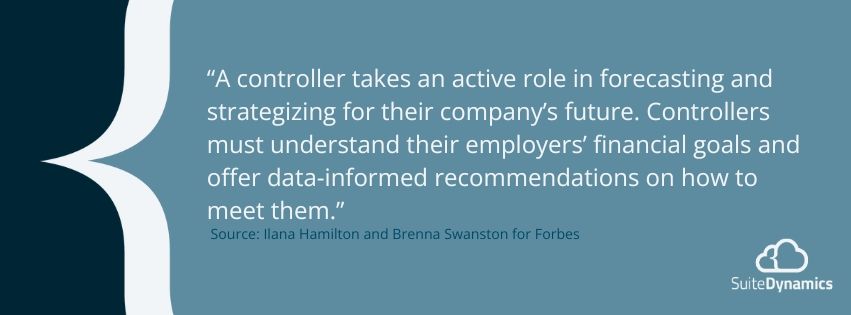
“Much of an accountant’s job description focuses on tracking current and past financial data,” an article in Forbes explains. “As the top accountants at their firms, these responsibilities are also part of a controller’s job. However, a controller takes an active role in forecasting and strategizing for the company’s future. Controllers must understand their employers’ financial goals and offer data-informed recommendations on how to meet them.”
Controllers typically work in private sector companies and focus on internal financial management and strategy. Their role is pivotal for maintaining the integrity and accuracy of a company's financial statements.
What is a Comptroller?
A comptroller is essentially a controller working in the public sector, such as in government agencies, non-profits, or educational institutions. A comptroller’s responsibilities include:
- Public Accountability: Ensuring the organization uses public funds efficiently and appropriately.
- Financial Oversight: Overseeing the financial operations and reporting for public entities.
- Auditing: Conducting or overseeing internal audits to ensure compliance with laws and regulations.
- Budget Management: Developing and managing budgets focusing on public accountability and transparency.
- Policy Implementation: Implementing financial policies that follow governmental regulations and standards.
“In some businesses, the position may be under that of the company’s chief financial officer (CFO),” The Corporate Finance Institute explains. “In other – usually smaller – companies, the comptroller may also occupy the position of CFO, or the company’s CFO may effectively assume comptroller duties even without holding that specific job title.”
Comptrollers bear a heavy responsibility for transparency and accountability due to their work’s public nature. Their role often involves more stringent auditing and reporting than controllers in the private sector.
Comptroller vs Controller: Key Characteristics
| Comptroller | Controller | ||
|---|---|---|---|
| 1 | Sector | Works in the public sector. | Typically works in the private sector. |
| 2 | Focus | Emphasizes public accountability, transparency, and regulatory compliance. | Focuses on internal financial management, accuracy, and strategic financial planning. |
| 3 | Duties | Oversees financial operations, audits, budget management, and policy implementation in public entities. | Manages internal controls, financial reporting, budgeting, and compliance within a company. |
| 4 | Reporting | Reports to government officials, the public, or a board of directors in a public entity. | Reports to senior management within a corporation. |
| 5 | Regulation | Follows governmental financial regulations and standards, often involving more rigorous audits. | Adheres to corporate financial regulations and standards. |
Challenges Faced by Comptrollers and Financial Controllers
Comptrollers and controllers ensure an organization’s financial integrity. Of course, the job can become demanding and complex, depending on the challenges faced. Below is a list of primary obstacles finance leaders must overcome to support a company’s success.
1. Managing Regulatory Compliance
Many companies struggle to keep up with frequent regulation changes. Some estimate that 3,000 to 4,500 new regulations emerge each year, and it’s the comptroller or controller’s job to ensure compliance with any that apply to their organization. Otherwise, their businesses might face penalties.
People in these positions must receive constant education to adapt to new legal requirements. Fortunately, ERP systems like NetSuite can help comptrollers and controllers adhere to regulations through compliance-related features.
For example, NetSuite’s governance, risk, and compliance (GRC) capabilities help establish and monitor intracompany controls. They also offer automated tools that reduce risk and boost financial integrity so businesses can follow regulatory guidelines without investing more time and effort.
2. Adapting to Globalization
Globalization presents another layer of complexity. Comptrollers and controllers in multinational companies deal with multiple currencies, varying tax laws, and varying financial regulations across countries. Therefore, they must have a deep understanding of international finance and an ability to adapt financial strategies to diverse regulatory environments.
Of course, the right software makes international financial management a feasible task. NetSuite OneWorld offers multibook features that allow companies to maintain accurate records in more than 190 currencies and navigate local and regional regulations worldwide. The system also provides real-time visibility into accounts payable, accounts receivable, inventory, fulfillment, and more so organizations can accelerate financial processes and better manage sprawling subsidiary networks.
3. Technological Advancements and Integration
For a while now, businesses and organizations have focused on cutting-edge technology. According to a Gartner Survey, artificial intelligence (AI) usage in business jumped 27.5% from 2010 to 2019, and that number will only increase.
Unfortunately, digital advancements are a double-edged sword for comptrollers and financial controllers. Tools such as AI, machine learning, and advanced analytics boost efficiency and accuracy but also require substantial training and integration investments. Controllers must find ways to leverage the full potential of these technologies and ensure their teams can handle the new software.
NetSuite helps users adapt to its system with educational features like guided learning, a series of interactive, role-based instructions that teach customers to navigate the software. Therefore, users can still complete tasks after upgrades.
SuiteDynamics experts also develop custom training programs that offer educational material and one-on-one instruction, helping companies fully utilize the system. Schedule a free consultation to discuss your training needs and start maximizing your NetSuite investment.
4. Talent Management and Leadership
Attracting and retaining skilled financial professionals is a persistent challenge for comptrollers and financial controllers. They must develop teams that can adapt to new technologies and regulatory changes, and they need to create work cultures that promote continuous learning and professional development so their organization can maintain competitive edges.
That’s another reason software training is crucial for a company’s health. Comptrollers and controllers must empower staff to navigate their systems and use the software to its full potential.
SuiteDynamics experts can help identify your team’s NetSuite knowledge gaps and devise ways to maximize your investment. Contact us today and start designing your custom training program.

5. Cybersecurity Threats
Unfortunately, an increased reliance on digital financial systems has heightened cybersecurity risks. The Identity Theft Resource Center’s 2023 Annual Data Breach Report says 2023 saw 3,205 data compromises, a 72% increase over the 2021 record high. IBM estimates that each breach costs $4.45 million on average.
Initially, cybersecurity seems like a chief technology officer’s responsibility. Yet, in an article for NetSuite, Rami Ali, NetSuite’s Senior Product Marketing Manager, writes that a controller has plenty of influence in this area, as well.
“In many organizations, chief technology officers report to the CFO, leaving finance executives, including the controller, in a good position to have an impact on —and even lead — security efforts,” he says.
In fact, cybersecurity has become a crucial aspect of financial management, demanding constant vigilance and proactive strategies. Financial controllers must prioritize cybersecurity to protect sensitive financial data from breaches and attacks. Ali suggests that one of the best ways to promote digital security is to advocate for cloud-based technology, which offers various protections.
For example, NetSuite’s application and operational security feature allows users to access the system from anywhere while blocking unauthorized network and service connections. It offers robust encryption, strong password policies, and role-based access controls. It also provides multi-factor and token-based application authentication to ensure only authorized personnel gain access.
6. Data Management and Integrity
According to Statista, the global data volume could reach 180 zettabytes by 2025. This explosion of data can challenge comptrollers and controllers since they must ensure financial data accuracy and integrity across the systems and departments.
ERP platforms like NetSuite offer some assistance by consolidating information into one database. This unification integrates disparate data sources, helps manage big data, and ensures real-time accuracy so companies can organize information effectively and boost financial reporting accuracy.
7. Economic Uncertainty
It’s difficult to predict what our economy will do and how its changes will impact businesses. For example, the average inflation rate soared from 1.4% in 2020 to 7% and 6.5% in 2021 and 2022 before falling back to 3.4% the following year. Consequently, businesses have dealt with rising costs and product shortages, and some have shuttered their operations.
Comptrollers and financial controllers must be able to forecast and adapt to economic fluctuations, managing risks associated with inflation, interest rate changes, and global economic shifts. They need effective risk management and scenario planning skills to navigate economic uncertainties and maintain financial stability.
NetSuite’s GRC features assist comptroller and controllers by monitoring and assessing customer, third-party, compliance, enterprise, and financial risks. The software offers company leadership as much information as possible to make better decisions and navigate economic fluctuations.
SuiteDynamics experts will explain more about NetSuite’s capabilities during your free consultation. We can discuss automation, reporting, security, training, and other system aspects that improve your company’s financial management process, increasing productivity and efficiency. Our team will ensure you get software that equips your organization to succeed.
Master Financial Management
At first, the comptroller vs. controller discussion may seem trivial, but these are vital positions that impact entire companies and organizations. They track financial performance, ensuring a company stays on budget and complies with all laws and regulations. Anyone who navigates the business world needs a working knowledge of their duties and differences.
Additionally, these positions are so critical to operations that their challenges reflect businesses' overall difficulties. Comptrollers and controllers must deal with globalization, economic uncertainty, cybersecurity, technological advancements, etc. A software system that equips them to handle these issues effectively can revolutionize an organization as a whole.
SuiteDynamics experts can implement a NetSuite ERP system for your business that’s molded to your specific needs. The software offers the automation, reporting, and organizational capabilities to streamline financial management and increase data accuracy so you can rest easy knowing your finances are in order.
Schedule a free consultation today to talk about your needs and how NetSuite can help meet your goals, creating a better, brighter future for your company.
We pull information from NetSuite material, SuiteDynamics experts, and other reliable sources to compose our blog posts and educational pieces. We ensure they are as accurate as possible at the time of writing. However, software evolves quickly, and although we work to maintain these posts, some details may fall out of date. Contact SuiteDynamics experts for the latest information on NetSuite ERP systems.
Part of this text was generated using GPT-3, OpenAI’s large-scale language-generation model. After generating the draft language, our team edited, revised, and fact-checked it to ensure readability and accuracy. SuiteDynamics is ultimately responsible for the content of this blog post.