
Casey Watson is the Marketing Communication Specialist for SuiteDynamics. She has a degree in journalism from Murray State University and over 10 years of experience researching and writing about various subjects, including insurance, nonprofit work, and healthcare. She has been covering NetSuite ERP systems for more than two years.
12 NetSuite Managed Services That Will Keep Your ERP Running At Its Best
A well-maintained system is a successful system.
Here's how to manage your ERP's upkeep.
If you’ve experienced a NetSuite Enterprise Resource Planning (ERP) implementation before, you know it doesn’t end with deployment; if you’re like many businesses, it doesn’t end at all. Once you've gone online, you must still sort out bugs, train staff to use the new software, expand and reconfigure the system as you grow, and more. Therefore, it helps to have ERP advisors on retainer.
Enter NetSuite Managed Services.
Our Managed Service plans include a variety of continuous support tasks that maintain and expand your ERP system so it runs without glitchy disruptions. This offering is an alternative to the Break-Fix model, focusing on preventative maintenance instead of reactive patching.
At SuiteDynamics, we include many support tasks in our NetSuite Managed Service plans, but clients request 12 most often. Read their descriptions, then schedule a free consultation with our team. We understand what’s at stake for your company and can develop a plan to maximize your NetSuite investment long after go-live.
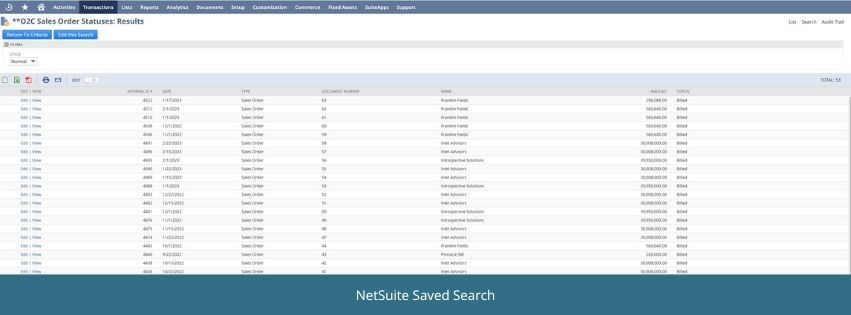
Our team builds basic and advanced financial reports and saved searches. We can do everything from configuring field filters and result sorting to writing function summaries and SQL formulas. You can request almost any kind of search or report, including:
- Advanced inventory tracking for manufacturing
- Rate calculation on late vendor deliveries
- Rates on late delivery for internal work orders
- Inventory control
- EBITDA
- Enhanced segmented financial views
- Comparative searches and reports

NetSuite is an enormous system with many small parts. In fact, its size and scope can get overwhelming, especially when you think about learning the steps for each function and teaching them to your team. But you shouldn’t stress.
Our team can create educational material for NetSuite Managed Services clients that demonstrates how to perform system tasks. These documents include step-by-step instructions and screenshots so your team can easily operate any software feature or customization.
We also provide other written materials that describe your system and how it's configured. Our API references and developer documentation offer comprehensive information about the software's functionalities, architecture, usage, and maintenance.
We give you all the information you need to create a report, track inventory, and perform any other necessary tasks.
ERP Health Checks
Like people, software systems need occasional check-ups to ensure they operate at their best. Our NetSuite Managed Services team can examine your ERP to see how it’s functioning.
First, our ERP advisors will analyze the system’s speed, considering any active automation that may affect processing times. Next, we’ll examine your system's operation, noting issues and identifying their root causes.
You’ll receive a thorough report detailing any system problems we find and offering recommendations for fixing them.
SuiteCommerce Strategy & SEO
Our NetSuite Managed Services team will configure or enhance your current SuiteCommerce website. We can complete any task, including:
- 1. Product page meta tags, keywords, and descriptions
- 2. Enhanced product detail page with improved product descriptions
- 3. Page speed optimization for improved search rankings
- 4. Faceted search, sorting, and filtering
- 5. Optimized web images for page load
- 6. Blog layout optimization
SuiteScript & Workflows

If you can dream up a NetSuite modification, we can typically build it with SuiteScript, particularly regarding automation. This programming language acts as the ERP’s secret weapon for customization. Our coders can use it to automate a process based on various criteria.
Our team also has expertise in building workflows, which are user-friendly methods for automating business processes. We make the software infrastructure so you can create custom automations with a few clicks. We develop workflows for processes such as:
- 1. Scheduling field updates
- 2. Sending automated emails
- 3. Building approval processes
SuiteDynamics also has experience building simple and advanced approval processes for procure-to-pay and the order-to-cash.
New Module Implementation
Our NetSuite Managed Services team can set up any NetSuite add-on modules. We understand the preferences, settings, and pitfalls associated with these features and can configure them correctly to achieve your desired results.
Clients commonly ask us to configure the following add-ons:
- 1. Advanced Billing
- 2. Advanced Revenue Management
- 3. Manufacturing Work-in-Process
- 4. Project Accounting and Management
- 5. Revenue Recognition
- 6. Supply Chain Management System (includes Advanced Manufacturing and Material Requirement Planning)
SuiteCommerce Development & Configuration
If you own a web store, you want to give customers the best online experience. That goal requires an engaging and dynamic website. Our NetSuite Managed Services team can customize your SuiteCommerce platform in any way you wish, including:
- 1. Theme upgrades
- 2. Sticky header and footer
- 3. Modern colors and typography
- 4. Expanded search, sorting, and filtering
- 5. Expanded hero banners
- 6. Improved readability
- 7. Mobile first factoring
- 8. Dynamics merchandizing content
- 9. Dynamically generate the most frequently searched items
- 10. Upsell/cross-sell based on minimum correlations
- 11. Expanded functionality
- 12. Embedded Google maps
- 13. Embedded customer review
- 14. Real-time chat functionality
- 15. Case management
General Support Across All NetSuite Modules

As you know, every software system experiences glitches and bugs occasionally. Our ERP advisors will review and troubleshoot any issues with your system. Additionally, we’ll maintain and improve your software by recommending new modules that will benefit your specific business processes.
Solution Design & Architecture
Every company is unique, so it’s common for a business to develop processes that no other company has. If that company uses NetSuite, the software must accommodate all its procedures.
SuiteDynamics specializes in designing and customizing NetSuite to fit non-standard business operations. We have built various customizations for processes ranging from accounting to auctions. Thus, we can create a NetSuite solution that suits your company, no matter how it operates.
Integration Development & Support

A NetSuite Cloud ERP can handle just about any business function, but that doesn’t mean you must give up the third-party programs you’ve used for years. Our NetSuite Managed Services team can customize the software to coordinate with any third-party program or e-commerce website so data can flow freely between your ERP and other systems.
NetSuite User Training
An ERP is worthless if you don’t know how to use it. Our ERP advisors offer one-on-one and team training to help your staff learn basic and advanced NetSuite functions. With our help, your employees will know the system and its customizations inside and out.
NetSuite CRM Automation

We can set up, configure, enhance, and maintain your NetSuite Customer Relationship Management module. This system handles the entire journey from lead to prospect to signed customer. You can also automate email and mail campaigns, create quotes and estimates, and manage all customer support cases through the software. Essentially, you can use it to generate a continuous stream of sales prospects.
Start Your NetSuite Managed Services Today
No one wants to sink large amounts of money into an ERP system only to have it crash and burn shortly after go-live.
We know your company has a lot riding on NetSuite’s success, and we want to ensure you get the best possible return on your investment. SuiteDynamics’ Managed Service Plans allow you to retain our experts and use them as needed after go-live. Whether you need a quick bug fixed or a new module implemented, we’ve got it.
Schedule your free consultation with our team today and rest well, knowing your ERP system is in the best hands.

We pull information from NetSuite material, SuiteDynamics experts, and other reliable sources to compose our blog posts and educational pieces. We ensure they are as accurate as possible at the time of writing. However, software evolves quickly, and although we work to maintain these posts, some details may fall out of date. Contact SuiteDynamics experts for the latest information on NetSuite ERP systems.

Failed NetSuite implementations are almost never about the software. NetSuite runs tens of thousands of businesses. The platform works. So when an implementation goes sideways because of blown budgets, missed go-live dates, or system nobody trusts yet, the instinct to blame the tool is understandable. But it's usually wrong. The failure typically lives in how the system was implemented, and in our experience rescuing troubled projects, it almost always traces back to one of five root causes. 1. The scope was underestimated from day one A lot of failed implementations were doomed before kickoff. The project was sold as a simple, clean migration, with standard configuration. Maybe a few months of work. Then reality hits when the legacy data was messier than anyone admitted. The "standard" processes turned out to have a dozen exceptions each, and custom requirements surfaced mid-project. When scope balloons after the contract is signed, two things happen: the budget and timeline blow up, and the team starts cutting corners to hit dates that were never realistic. Neither ends well. 2. The system was configured without business context This one is subtle, because on paper everything looks fine. The consultants knew NetSuite inside and out, and the configuration follows best practices, yet the system fights your team at every turn. The problem is that knowing NetSuite isn't the same as knowing your business. If the people configuring the system never sat with your warehouse team, never traced an order from quote to cash, or never asked why you do things the way you do, you end up with a technically correct system built for a company that isn't yours. 3. Data migration was rushed or sloppy Garbage in, garbage out. It's a cliché because it keeps happening. The trap is that a data migration can be technically "complete," with every record moved and every checkbox ticked, while you still have unusable data. Duplicate customers, items with wrong costing, or open transactions that don't reconcile are all things we see regularly during implementation rescues. We even see historical records mapped to the wrong accounts. The migration passed, but your team can't trust the subsequent reports. Bad data quietly poisons everything downstream, and it's often the last problem anyone diagnoses because the migration was marked "done" months ago. 4. Nobody actually tested against real workflows There's a big difference between "the feature works" and "the feature works for how we operate." Failed implementations are full of the first and starved of the second. Real testing means running your actual scenarios. If features were validated in a vacuum (or worse, marked complete without validation at all) the problems don't show up until go-live, when they're most expensive to fix. 5. No one owned the project end-to-end Implementations are long, and it's not uncommon for consulting firm swaps team members during a project. Each handoff loses context, and eventually nobody on either side holds the full picture of what was decided, why, and what's still open. Missing ownership is why so many troubled projects feel unaccountable. Every issue is somebody else's decision from six months ago, and no one can explain the reasoning behind it. The fix depends on the point of failure If your NetSuite implementation is in trouble, the temptation is to start fixing symptoms by patching reports, adding workarounds, and retraining users. A real rescue starts with diagnosis to figure out which of these five failures happened on your project. Treating the wrong root cause just adds cost on top of a project that's already over budget. The good news: implementations can be rescued . The system underneath is solid. What went wrong is fixable once you know exactly what went wrong. Schedule a rescue assessment with our team to get started on the right path.

Job shop manufacturing is a production strategy focused on customization over volume.

The future of manufacturing planning is in systems designed to flex and reflect how work actually happens in job shops with tools like Dynamic Job Shop.

Explore Esusu's partnership with SuiteDynamics to enhance financial processes. Schedule a consultation to see how your business can thrive with NetSuite solutions.

Spreadsheets built modern business. For decades they served as the unofficial operating system of job shops and custom manufacturers everywhere. They are flexible, familiar, and just comfortable enough to feel like a real solution. In the early days of a growing shop, they genuinely work. But as make-to-order complexity increases, as custom BOMs multiply, lead times tighten, and engineering revisions pile up, spreadsheets strain under the pressure. Every job is different, but spreadsheets want everything to be the same. In make-to-order environments, no two jobs are identical. Unique BOMs, custom routings, variable material costs, different setup requirements, customer-specific specs. Spreadsheets, though, thrive on repetition and standardized rows. So the more variation you introduce, the more tabs you create. The more exceptions you add, the more manual overrides appear. The more formulas you patch together, the more fragile the whole thing becomes. Eventually, the file turns into something only one person truly understands. That’s a liability, not a system. Capacity becomes a guessing game. In make-to-order shops, capacity isn’t theoretical. It’s constrained by reality. Machines go down. Operators vary in skill. Setup time fluctuates from job to job. Rush orders blow up carefully planned weeks. Spreadsheets struggle here because they’re built on static inputs. You can build a beautiful planning sheet with machine-hour allocations, but unless it dynamically adjusts for real-time job status, operator availability, overlapping resource conflicts, and maintenance downtime, you’re not really planning. You’re forecasting best-case scenarios. And that’s exactly how shops overpromise delivery dates and end up paying for it later in overtime and expediting costs. Engineering changes don’t cascade cleanly. Change is a constant in make-to-order manufacturing. A customer tweaks a dimension, a material substitution becomes necessary, or a tolerance tightens halfway through production. In an integrated system, that change automatically updates BOMs, routings, cost projections, and scheduling impact all at once. In a spreadsheet environment, it depends entirely on who remembers to update which tab. A routing might change without adjusting the labor estimate. A material substitution might never feed into the margin calculation. A lead-time adjustment might not reach the production schedule until it’s too late. These small disconnects multiply quickly, and because spreadsheets have no enforced relationships between data sets, the errors don’t announce themselves. Institutional knowledge becomes a single point of failure. Ask most growing job shops who owns the master spreadsheet and you’ll get a name. One estimator, planner, or operations manager who has become the living interpreter of years’ worth of embedded formulas, assumptions, and logic that nobody else fully understands. This works fine until it doesn’t. When that person goes on vacation, gets sick, or leaves, the shop loses operational clarity. In an environment already defined by complexity, having critical knowledge live inside one person’s mental model of a file is an inefficient bottleneck. Visibility stops at the file boundary. Spreadsheets are static snapshots. Make-to-order manufacturing is anything but. Without real-time feedback loops, shops find themselves unable to answer questions that should be simple: Are we actually on track this week? Which jobs are consuming more labor than quoted? Where is the bottleneck right now? Which customers consistently drive margin compression? When performance data doesn’t flow automatically from the floor back into quoting and planning, improvement stalls. You can’t refine what you can’t see. Here’s the thing about spreadsheet failure in manufacturing… it’s not dramatic. It’s gradual. First the files get slow, then fragile, then opaque. By the time leadership feels the real pain through late shipments, squeezed margins, and rising overtime, the architectural issues are widespread. Make-to-order manufacturing demands systems that understand relationships: how a routing affects capacity, how a BOM revision affects cost, how a delayed job cascades through the rest of the schedule. The question most shops ask is whether they can make the spreadsheets work. The better question is what it’s actually costing to keep them. The most resilient make-to-order manufacturers are building systems that preserve flexibility without sacrificing the visibility needed to actually run the business. Adaptability is the advantage.

In custom manufacturing , when systems break down, profit rarely disappears all at once. It leaks. Quietly, repeatedly, and often in ways that never show up clearly on any report. Walk into almost any fabrication shop and you’ll hear some version of the same story: the backlog is strong, revenue looks good, we’re staying busy. And yet the margin feels thinner than it should. For job shops running custom work, profitability doesn’t usually collapse because of one bad decision. It erodes through small, daily inefficiencies buried inside quoting, scheduling, engineering changes, and the gap between what was planned and what actually happened on the floor. Here’s where shops most commonly lose efficiency, and how to get it back. The quote that was almost right. For custom orders, every quote is a prediction, and predictions are dangerous when they’re disconnected from real shop-floor data. Outdated labor standards, underestimated setup time, material prices that changed since the template was built, and capacity assumptions based on average weeks instead of current reality. These errors are each small on their own, but a 4% underestimate on labor here, a missed secondary operation there, add up across hundreds of jobs. Small errors compound into real margin loss. The best-performing shops treat quoting as a living system fed by actual job performance data, not static spreadsheets that nobody updates. Capacity that looks available but isn’t. On paper, there’s open space on the schedule. In practice, that open week includes a machine down for maintenance, a senior operator on vacation, two complex jobs already competing for the same bottleneck, and a rush order someone verbally committed to last Thursday. Without finite capacity planning, shops routinely overcommit based on theoretical machine hours rather than real-world constraints. The fallout is predictable: overtime spikes, expedited shipping costs, re-sequencing chaos, and exhausted operators. Margin shrinks not because the shop is incapable, but because it’s planning in averages. Engineering changes that never get repriced. Designs evolve. A hole moves, a weld spec changes, or a tolerance tightens. Each adjustment has a cost. But many shops hesitate to reprice midstream, worried about damaging the customer relationship, and end up absorbing the extra labor and rework time instead. Do this enough times and it becomes a cultural norm: “we’ll just take care of it.” That’s margin erosion disguised as good service. High-performing job shops track engineering change impact in real time and make repricing decisions based on data rather than discomfort. Setup time hiding in plain sight. In low-volume, high-mix environments, setup time is often the silent killer. When shops don’t track setup separately from run time, assume it’ll all come out in the wash, and never refine their routings based on what actually happened, they end up underpricing complexity. In job shops producing one to fifty unit runs, setup can represent a disproportionate share of total labor. If it isn’t measured accurately, it can’t be priced accurately. The spreadsheet layer nobody talks about. Most shops run a hybrid environment where the ERP handles transactions and spreadsheets handle reality. Capacity lives in one file, quoting assumptions in another, and actual job performance in someone’s head. This creates invisible disconnects. Quotes not aligned with current routing, schedules that don’t reflect real constraints, and historical performance that never feeds forward into better decisions. Each disconnect feels manageable in isolation. Collectively, they create margin leakage that leadership can feel but can’t quite locate. What makes all of this so frustrating isn’t that shop owners don’t care. It’s that they can’t see clearly enough to act decisively. Without integrated visibility across quoting, routing, capacity, and quality, operators run on instinct. And instinct works remarkably well until scale and complexity outpace it. The shops that consistently outperform aren’t necessarily the biggest or the busiest. They operate with clarity and consistency. Fewer assumptions and more decisions based on reality. In a manufacturing landscape where lead times keep shrinking and customers expect speed and precision at the same time, margin won’t be protected by effort alone.

Finite capacity planning asks: Given the resources we actually have, when is this job realistically possible?

NetSuite’s Model Context Protocol (MCP), built in partnership with Anthropic, helps users leverage AI

Uncover the challenges of data quality affecting DIO accuracy, from ghost inventory to inconsistent formats. Find out how to tackle these issues effectively with a NetSuite ERP.

In the world of private equity, creating operational value has become increasingly critical as the market evolves. With exit timelines extending and competition for deals intensifying, PE firms are looking beyond financial engineering to drive returns. One emerging strategy that's gaining traction is the consolidation of NetSuite instances across portfolio companies. The Hidden Challenge of System Fragmentation As PE portfolios grow through acquisition, a common pattern emerges: multiple portfolio companies operating on separate NetSuite instances. While each system may work effectively in isolation, the fragmentation creates significant operational inefficiencies at the portfolio level: Redundant Licensing Costs: Each separate instance requires its own licensing structure , creating unnecessary expenses that directly impact EBITDA. Manual Consolidation Effort: Finance teams spend countless hours extracting, transforming, and manually consolidating data from disparate systems. Inconsistent Processes: Basic business functions are handled differently across portfolio companies, limiting standardization efforts. Limited Portfolio-Wide Visibility: Gaining insight across the entire portfolio requires extensive manual effort, delaying strategic decision-making. Integration Challenges: Onboarding new acquisitions becomes increasingly complex when each company maintains its own environment.
