The Role of a NetSuite ERP System in Modernizing F&B Manufacturing Processes

You can make a lot of money in the food and beverage sector if you have the right software to help navigate the industry's pitfalls.


There are no easy wins in the food and beverage (F&B) industry. Manufacturers must navigate strict regulations, rising consumer expectations, and sustainability issues to survive.


However, the 8 billion people on this planet have to eat, so it’s also a lucrative field. According to Market Research, experts believe the global market will balloon to $8.9 trillion in 2026.


Manufacturers can generate plenty of revenue if they manage their businesses effectively and keep up with demand. Fortunately, the right technology can help that happen.


A NetSuite Enterprise Resource Planning (ERP) System helps F&B manufacturers modernize their processes using a unified platform that streamlines operations. This guide details how the software improves supply chain management, production, quality control, financial management, and more to create a more efficient and effective manufacturing operation.


SuiteDynamics is a NetSuite Alliance Partner, meaning we work with NetSuite to customize and implement ERP systems. Our experts can help assess your business and find the right NetSuite solutions to transform your company into an industry leader.


Discover more about the system below, then schedule a free consultation with our team. We’ll show you a better way to build your business.

Schedule a FREE Consultation
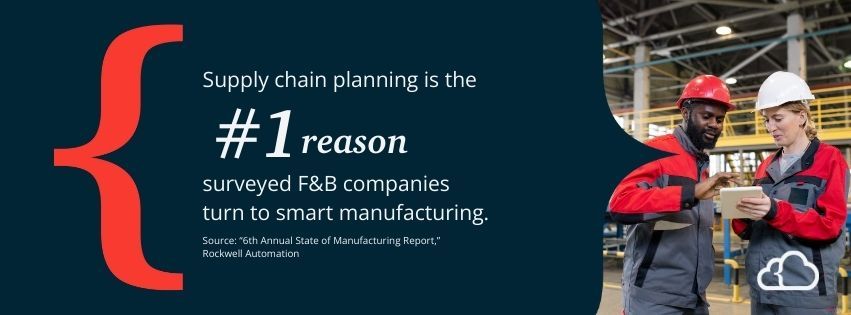
Graphic stating that supply chain planning is the #1 reason surveyed F&B companies turn to smart manufacturing.


Optimizing Supply Chain Management


The supply chain can be the bane of a manufacturing company’s existence, particularly for businesses in the F&B industry that must deal with a climate run amok. Weather-related events not only cause distribution issues but also limit the supplies themselves. For example, one-third of the world’s corn is currently located in water-stressed regions.


In recent years, grain supplies have also lagged because water levels were too low for transport barges, hydropower has suffered from drought, and extreme heat has put outdoor laborers at risk. As the climate grows warmer, F&B manufacturers will have to deal with even more supply chain disruptions. Companies must invest in effective supply chain management technology before the issues worsen. In fact, Rockwell Automation says supply chain planning is the top reason F&B companies turn to smart manufacturing.


A NetSuite ERP system helps manufacturers prepare for supply chain issues with a unified platform that integrates all supply chain aspects, from procurement and production to distribution and sales. This integration ensures seamless coordination between different departments and external partners so they can better handle supply shortages and find new sources quickly.


The system also allows F&B manufacturers to forecast demand more accurately, plan production schedules effectively, and optimize logistics operations. A holistic approach to supply chain management minimizes delays, reduces costs, and improves customer satisfaction by ensuring timely product delivery.


Schedule your free consultation with the SuiteDynamics team to learn more about NetSuite’s supply chain management capabilities and how they can help your company weather the inevitable disruptions that will limit your resources.


Schedule a FREE Consultation


Streamlining Production with Real-Time Data


One of NetSuite’s best features is its ability to provide real-time data throughout the manufacturing process. It allows F&B manufacturers to monitor production lines, track inventory levels, and manage resources efficiently. This instant access to accurate data empowers manufacturers to make decisions quickly, reducing downtime and improving overall productivity.


For example, the system’s real-time inventory management feature allows manufacturers to monitor stock levels so they can minimize shortages and excess inventory. This capability is crucial for F&B companies, especially those selling perishable goods that must ensure product freshness.


In an article for Tech Times, Carl Williams writes that these insights are quickly becoming an industry staple.

“By integrating big data analytics into every facet of the business, F&B companies can not only anticipate market changes but also shape them,” he says. “The advent of advanced analytics, AI, and machine learning technologies promises even better insights and more innovative applications.”


Your business must take advantage of cutting-edge technology and analytics to keep up. Schedule your free consultation to discover what insights NetSuite can provide and how they can shape your company’s operations.


Enhancing Quality Control and Compliance


In the F&B sector, companies must prioritize quality control and regulatory compliance. Otherwise, they may violate the law, pose a risk to public safety, and lose significant business.


NetSuite ERP systems automate compliance processes and keep detailed records, helping users adhere to strict quality standards and regulatory requirements. The system's traceability features also allow manufacturers to track ingredients and finished products throughout the supply chain, ensuring transparency and accountability.


Additionally, NetSuite’s integrated quality management module facilitates regular inspections and testing so products meet required standards before reaching consumers, enhancing product quality and reducing the risk of costly recalls.


Graphic stating that 94% of F&B survey respondents said their businesses invested in innovation.


Facilitating Innovation and Scalability


Innovation is key to staying ahead in the F&B market. The industry is so competitive that companies must constantly search for ways to improve their products and operations—or else they’ll lose business to more creative competition. According to a 2018 report from Green, Hasson, & Janks, 94% of F&B survey respondents said their businesses invested in innovation, and 50% said they did so at customers’ requests.


One of the best ways to innovate is through internal technology. It allows your processes, from supply chain to manufacturing to distribution, to operate efficiently, creating a better buying experience.


A NetSuite ERP system supports innovation by providing a flexible and scalable platform that can adapt to changing business needs. Manufacturers can easily introduce new products, expand into new markets, and scale operations without the limitations imposed by outdated systems.


The system’s cloud-based nature also ensures manufacturers can access the latest features and updates without costly and time-consuming upgrades. This ability allows F&B businesses to stay responsive to market trends and consumer demands.


Boosting Distribution


The online shopping experience is changing, and consumers now expect lightning-fast shipping from manufacturers and retailers. In fact, 68% of surveyed online shoppers cited delivery speed as a top factor for choosing retailers, according to research from Digital Commerce 360 and Bizrate Insights.


“Consumers rank delivery speed second [behind free shipping], as shoppers are accustomed to receiving their orders fast in an Amazon world,” Lauren Freedman writes for Digital Commerce 360. “Each retailer needs to assess the most desirable logistics solutions and associated costs amid heightened expectations.”


A NetSuite ERP system helps establish a smooth, efficient delivery process. It offers real-time visibility into inventory levels, allowing manufacturers to efficiently manage stock, reduce excess inventory, and minimize stockout risks. Its advanced demand planning and forecasting tools also help manufacturers better predict customer needs and optimize inventory levels to meet demand.


The system's automated order management capabilities boost customer satisfaction, as well, by streamlining the order-to-cash process, improving order fulfillment rates, reducing errors, and ensuring timely and accurate deliveries. Additionally, NetSuite’s Ship Central feature streamlines warehouse operations by integrating shipping processes directly with the ERP system, improving efficiency and accuracy.


Finally, NetSuite's robust analytics and reporting tools offer valuable insights into critical performance metrics. They help manufacturers make informed decisions and improve operational efficiency and responsiveness.


Schedule a free consultation with SuiteDynaics experts to learn more about how the system can improve your shipping processes and boost customer satisfaction.


Schedule a FREE Consultation
Graphic stating that 82% of businesses fail due to poorly managed cash flow.


Improving Financial Management


All businesses must excel at financial management, and F&B manufacturers are no different.

According to The Hartford, one study found that 82% of businesses fail due to poorly managed cash flow. That’s a jaw-dropping statistic, and if F&B manufacturers want to avoid that fate, they must invest in sufficient financial management software.


NetSuite’s ERP system offers robust financial management tools and comprehensive financial performance visibility. Manufacturers that use it can easily track expenses, manage budgets, and generate accurate financial reports.


The system’s automated accounting features also reduce the risk of errors and streamline financial processes, freeing up valuable time for strategic planning and decision-making. By integrating financial data with other business processes, NetSuite provides a holistic view of the company’s operations, enabling better financial control and planning.


SuiteDynamics employs financial and business experts who can help assess your company’s financial operations and develop practical NetSuite solutions that improve your processes. We can even demo the system so you can see its revolutionary features first-hand. Contact us today and start your journey toward digital transformation.


Schedule a FREE Consultation


Equip Your Company to Rise


The F&B industry is fiercely competitive, and manufacturers face many obstacles, including strict regulations, rising customer expectations, and an unpredictable climate that could increasingly impact their businesses. These issues make advanced software systems a must for successful industry members.


In fact, they’ve already proven vital for mitigating the effects of recent global events. According to ECI Software Solutions’ “2021 State of Manufacturing Digital Transformation Survey,” almost 95% of manufacturing companies that used ERP systems during the COVID-19 pandemic said they helped them navigate that period's challenges.


A NetSuite ERP system stands out in its field because it offers powerful features that help F&B manufacturers operate more efficiently, innovate continuously, and achieve sustainable growth. SuiteDynamics experts can also ensure the software provides for your company’s unique needs so you can stay competitive and exceed your goals.   


Schedule your free consultation today and experience a business that runs better than you thought possible.


Schedule a FREE Consultation


We pull information from NetSuite material, SuiteDynamics experts, and other reliable sources to compose our blog posts and educational pieces. We ensure they are as accurate as possible at the time of writing. However, software evolves quickly, and although we work to maintain these posts, some details may fall out of date. Contact SuiteDynamics experts for the latest information on NetSuite ERP systems.


Part of this text was generated using GPT-3, OpenAI’s large-scale language-generation model. After generating the draft language, our team edited, revised, and fact-checked it to ensure readability and accuracy. SuiteDynamics is ultimately responsible for the content of this blog post.

March 27, 2026
Spreadsheets built modern business. For decades they served as the unofficial operating system of job shops and custom manufacturers everywhere. They are flexible, familiar, and just comfortable enough to feel like a real solution. In the early days of a growing shop, they genuinely work. But as make-to-order complexity increases, as custom BOMs multiply, lead times tighten, and engineering revisions pile up, spreadsheets strain under the pressure. Every job is different, but spreadsheets want everything to be the same. In make-to-order environments, no two jobs are identical. Unique BOMs, custom routings, variable material costs, different setup requirements, customer-specific specs. Spreadsheets, though, thrive on repetition and standardized rows. So the more variation you introduce, the more tabs you create. The more exceptions you add, the more manual overrides appear. The more formulas you patch together, the more fragile the whole thing becomes. Eventually, the file turns into something only one person truly understands. That’s a liability, not a system. Capacity becomes a guessing game. In make-to-order shops, capacity isn’t theoretical. It’s constrained by reality. Machines go down. Operators vary in skill. Setup time fluctuates from job to job. Rush orders blow up carefully planned weeks. Spreadsheets struggle here because they’re built on static inputs. You can build a beautiful planning sheet with machine-hour allocations, but unless it dynamically adjusts for real-time job status, operator availability, overlapping resource conflicts, and maintenance downtime, you’re not really planning. You’re forecasting best-case scenarios. And that’s exactly how shops overpromise delivery dates and end up paying for it later in overtime and expediting costs. Engineering changes don’t cascade cleanly. Change is a constant in make-to-order manufacturing. A customer tweaks a dimension, a material substitution becomes necessary, or a tolerance tightens halfway through production. In an integrated system, that change automatically updates BOMs, routings, cost projections, and scheduling impact all at once. In a spreadsheet environment, it depends entirely on who remembers to update which tab. A routing might change without adjusting the labor estimate. A material substitution might never feed into the margin calculation. A lead-time adjustment might not reach the production schedule until it’s too late. These small disconnects multiply quickly, and because spreadsheets have no enforced relationships between data sets, the errors don’t announce themselves. Institutional knowledge becomes a single point of failure. Ask most growing job shops who owns the master spreadsheet and you’ll get a name. One estimator, planner, or operations manager who has become the living interpreter of years’ worth of embedded formulas, assumptions, and logic that nobody else fully understands. This works fine until it doesn’t. When that person goes on vacation, gets sick, or leaves, the shop loses operational clarity. In an environment already defined by complexity, having critical knowledge live inside one person’s mental model of a file is an inefficient bottleneck. Visibility stops at the file boundary. Spreadsheets are static snapshots. Make-to-order manufacturing is anything but. Without real-time feedback loops, shops find themselves unable to answer questions that should be simple: Are we actually on track this week? Which jobs are consuming more labor than quoted? Where is the bottleneck right now? Which customers consistently drive margin compression? When performance data doesn’t flow automatically from the floor back into quoting and planning, improvement stalls. You can’t refine what you can’t see. Here’s the thing about spreadsheet failure in manufacturing… it’s not dramatic. It’s gradual. First the files get slow, then fragile, then opaque. By the time leadership feels the real pain through late shipments, squeezed margins, and rising overtime, the architectural issues are widespread. Make-to-order manufacturing demands systems that understand relationships: how a routing affects capacity, how a BOM revision affects cost, how a delayed job cascades through the rest of the schedule. The question most shops ask is whether they can make the spreadsheets work. The better question is what it’s actually costing to keep them. The most resilient make-to-order manufacturers are building systems that preserve flexibility without sacrificing the visibility needed to actually run the business. Adaptability is the advantage. 
March 23, 2026
In custom manufacturing , when systems break down, profit rarely disappears all at once. It leaks. Quietly, repeatedly, and often in ways that never show up clearly on any report. Walk into almost any fabrication shop and you’ll hear some version of the same story: the backlog is strong, revenue looks good, we’re staying busy. And yet the margin feels thinner than it should. For job shops running custom work, profitability doesn’t usually collapse because of one bad decision. It erodes through small, daily inefficiencies buried inside quoting, scheduling, engineering changes, and the gap between what was planned and what actually happened on the floor. Here’s where shops most commonly lose efficiency, and how to get it back. The quote that was almost right. For custom orders, every quote is a prediction, and predictions are dangerous when they’re disconnected from real shop-floor data. Outdated labor standards, underestimated setup time, material prices that changed since the template was built, and capacity assumptions based on average weeks instead of current reality. These errors are each small on their own, but a 4% underestimate on labor here, a missed secondary operation there, add up across hundreds of jobs. Small errors compound into real margin loss. The best-performing shops treat quoting as a living system fed by actual job performance data, not static spreadsheets that nobody updates. Capacity that looks available but isn’t. On paper, there’s open space on the schedule. In practice, that open week includes a machine down for maintenance, a senior operator on vacation, two complex jobs already competing for the same bottleneck, and a rush order someone verbally committed to last Thursday. Without finite capacity planning, shops routinely overcommit based on theoretical machine hours rather than real-world constraints. The fallout is predictable: overtime spikes, expedited shipping costs, re-sequencing chaos, and exhausted operators. Margin shrinks not because the shop is incapable, but because it’s planning in averages. Engineering changes that never get repriced. Designs evolve. A hole moves, a weld spec changes, or a tolerance tightens. Each adjustment has a cost. But many shops hesitate to reprice midstream, worried about damaging the customer relationship, and end up absorbing the extra labor and rework time instead. Do this enough times and it becomes a cultural norm: “we’ll just take care of it.” That’s margin erosion disguised as good service. High-performing job shops track engineering change impact in real time and make repricing decisions based on data rather than discomfort. Setup time hiding in plain sight. In low-volume, high-mix environments, setup time is often the silent killer. When shops don’t track setup separately from run time, assume it’ll all come out in the wash, and never refine their routings based on what actually happened, they end up underpricing complexity. In job shops producing one to fifty unit runs, setup can represent a disproportionate share of total labor. If it isn’t measured accurately, it can’t be priced accurately. The spreadsheet layer nobody talks about. Most shops run a hybrid environment where the ERP handles transactions and spreadsheets handle reality. Capacity lives in one file, quoting assumptions in another, and actual job performance in someone’s head. This creates invisible disconnects. Quotes not aligned with current routing, schedules that don’t reflect real constraints, and historical performance that never feeds forward into better decisions. Each disconnect feels manageable in isolation. Collectively, they create margin leakage that leadership can feel but can’t quite locate. What makes all of this so frustrating isn’t that shop owners don’t care. It’s that they can’t see clearly enough to act decisively. Without integrated visibility across quoting, routing, capacity, and quality, operators run on instinct. And instinct works remarkably well until scale and complexity outpace it. The shops that consistently outperform aren’t necessarily the biggest or the busiest. They operate with clarity and consistency. Fewer assumptions and more decisions based on reality. In a manufacturing landscape where lead times keep shrinking and customers expect speed and precision at the same time, margin won’t be protected by effort alone.
January 5, 2026
Every manufacturing leader has lived this moment: The schedule looks perfect. Orders are slotted. Commitments are made. And then reality shows up. A machine goes down. A key operator calls out. Setup times balloon. One late job cascades into five. Suddenly the plan (built meticulously inside your ERP) falls apart. Not because your team failed, but because the plan was never grounded in reality to begin with.  The Hidden Lie Inside Most ERP Schedules
August 27, 2025
NetSuite’s Model Context Protocol (MCP) , built in partnership with Anthropic, helps users leverage AI to ask simple, natural-language questions and get back complex, structured analysis, all powered by live NetSuite data. This practical use of AI can be used to generate reports, create or update records, perform queries, analyze reports, automate workflows, or make predictions based on real-time data. Here's how you can get started and connect AI to NetSuite using MCP: 1. Login to NetSuite and navigate to Customization → SuiteCloud Development → SuiteApp Marketplace. 2. Search “MCP Tools” > Click on the icon and install the MCP Tools SuiteApp
job shop manufacturing
June 20, 2025
Job shop manufacturing is a production method where small batches of 1-100 units of customized or unique products are made to meet specific customer requirements. Unlike mass production, each order typically requires unique setups, specialized processes, and custom routing through the facility. In this comprehensive guide, you'll learn: The complete definition of job shop manufacturing How job shops differ from other manufacturing types Industries that rely on job shop methods Technology solutions that optimize job shop operations When to consider implementing specialized ERP systems What is Job Shop Manufacturing? (Definition) Job shop manufacturing is a production strategy focused on customization over volume . Instead of producing thousands of identical items, job shops create small quantities of unique products tailored to specific customer specifications. Key defining characteristics: Small batch sizes - Typically 1-100 units per order High product variety - Hundreds or thousands of different products Custom specifications - Each order has unique requirements Project-based workflow - Work orders last days to weeks Skilled labor - Requires specialized expertise and flexibility Job Shop is a powerful, fully integrated solution built for custom manufacturers, combining quoting, configuration, production, and fabrication workflows inside NetSuite. Learn more about SuiteDynamics' NetSuite Job Shop for Manufacturing.
A man is holding a box and a woman is looking at a tablet in a warehouse.
By Grace Martin May 27, 2025
Uncover the challenges of data quality affecting DIO accuracy, from ghost inventory to inconsistent formats. Find out how to tackle these issues effectively with a NetSuite ERP.
May 8, 2025
In the world of private equity, creating operational value has become increasingly critical as the market evolves. With exit timelines extending and competition for deals intensifying, PE firms are looking beyond financial engineering to drive returns. One emerging strategy that's gaining traction is the consolidation of NetSuite instances across portfolio companies. The Hidden Challenge of System Fragmentation As PE portfolios grow through acquisition, a common pattern emerges: multiple portfolio companies operating on separate NetSuite instances. While each system may work effectively in isolation, the fragmentation creates significant operational inefficiencies at the portfolio level: Redundant Licensing Costs: Each separate instance requires its own licensing structure , creating unnecessary expenses that directly impact EBITDA. Manual Consolidation Effort: Finance teams spend countless hours extracting, transforming, and manually consolidating data from disparate systems. Inconsistent Processes: Basic business functions are handled differently across portfolio companies, limiting standardization efforts. Limited Portfolio-Wide Visibility: Gaining insight across the entire portfolio requires extensive manual effort, delaying strategic decision-making. Integration Challenges: Onboarding new acquisitions becomes increasingly complex when each company maintains its own environment.
Esusu logo
April 30, 2025
Explore Esusu's partnership with SuiteDynamics to enhance financial processes. Schedule a consultation to see how your business can thrive with NetSuite solutions.
Image of an office worker and a laptop, illustrating the concept of case management setup.
By Brittany Klecker April 30, 2025
Discover how to effectively set up and configure case statuses, rules, types, priorities, and more in NetSuite's case management system. Streamline your workflow and improve customer support with this comprehensive guide.
A man is holding a stack of cardboard boxes in a warehouse.
By Grace Martin April 26, 2025
Backorders disrupt revenue and frustrate customers. Learn what "backordered" means, how backorders happen, their impact on businesses, and how NetSuite ERP can minimize the issues.
More Posts