Which ERP trend will impact your business the most in 2023?

As 2023 progresses, we expect ERPs to evolve in line with the changing business world. Here's what we think will happen.
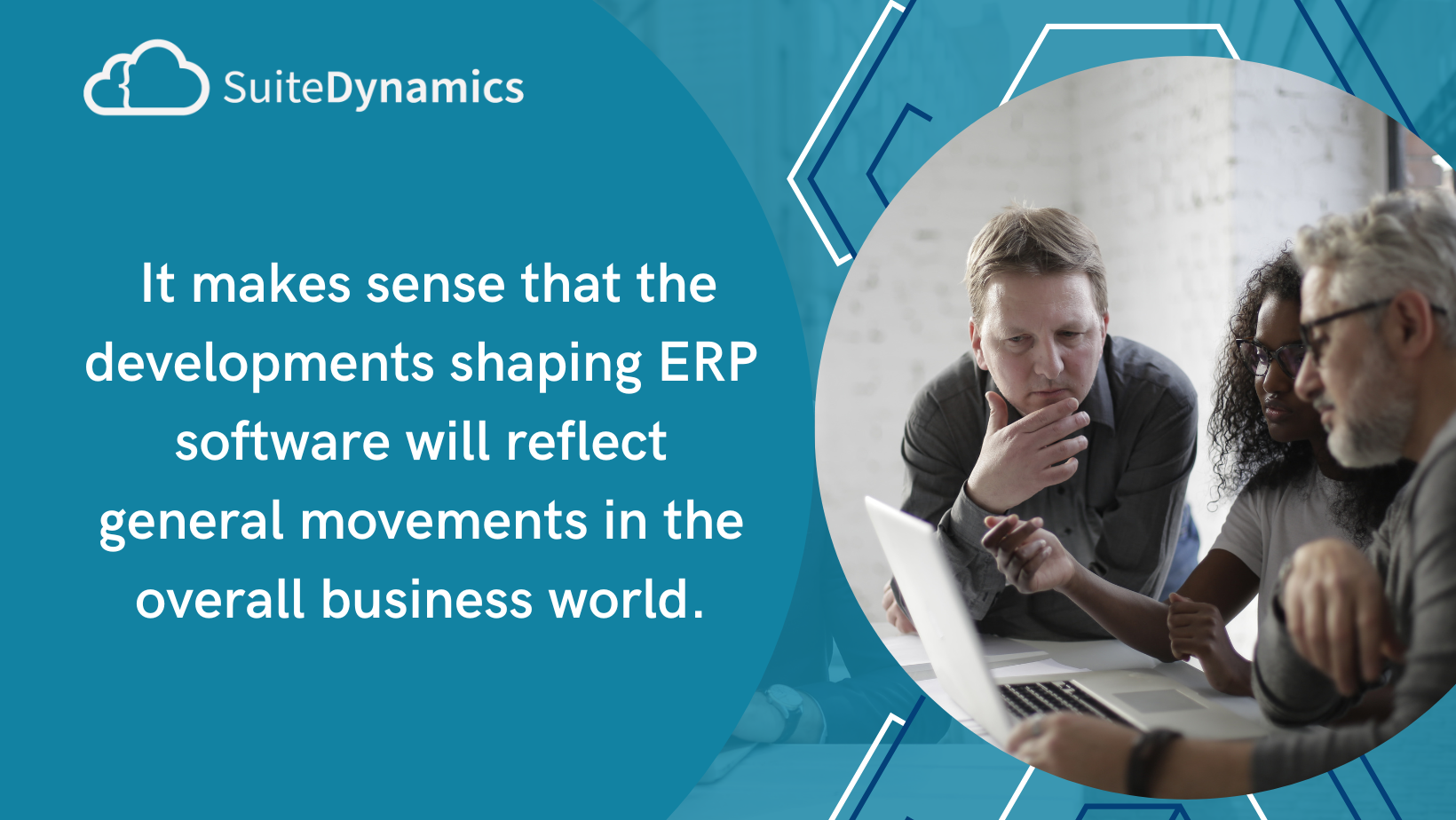


This photo illustrates the concept of an ERP trend. It features coworkers collaborating on a laptop.


Why should you care about an ERP trend? Because technology is constantly changing and shaping the business world. And Enterprise Resource Planning software has been at the forefront of that evolution for years. 


In fact, Technology Evaluation Centers reports that nearly 50% of companies are planning for, actively acquiring, or upgrading an ERP system. And according to Market Research Engine, the global ERP market will exceed $49.5 billion by 2027


Therefore, it makes sense that the developments shaping this software will reflect general movements in the overall business world. So, let’s look at a few significant ERP trends for 2023.


1. Mobile apps will become more powerful. 


Users don’t want to be trapped at their desks anymore. Instead, they want to travel, visit clients, monitor warehouses, or just work from home. That’s why mobile compatibility will remain a significant ERP trend in 2023. 


Software vendors have been working on several key features that users can access through mobile devices. For example, NetSuite has developed a mobile app that can:


  • Track billable hours.
  • Maintain a NetSuite calendar. 
  • Log expenses and attach receipts.
  • Maintain records.
  • Monitor important business information.
  • Track business calls and assign them to companies and customers.


One size doesn’t fit all in the ERP world.


And at SuiteDynamics, we believe this list is just a kickstart for NetSuite’s mobile capabilities. As we all know, technology has a phone-sized future, and we expect this fact to guide ERP software development.


2. More businesses will consider a cloud-based system one of the best ERP solutions.


Mobile compatibility goes with cloud reliance like digital marketing goes with analytics. You can’t have the former without the latter. 


Cloud-based ERP systems allow employees to access the software anywhere in the world through their mobile devices. That’s a drastic change from on-premises systems that require staff to log in on location. And it also explains why on-premises systems are becoming obsolete. 


So, as more employees transition to remote work, more companies will see the beauty in internet operations. And fewer organizations will house their own ERP servers, especially as security for cloud systems improves. 


3. Providers will produce more industry-specific software.


One size doesn’t fit all in the ERP world. Many companies need systems tailored to their needs, but few want to build an ERP from scratch.


And fortunately, most won’t have to. 


ERP providers have realized that most businesses within a given field use the same features. So, they’ve started creating software versions tailored to specific industries. 


For example, NetSuite has developed a product called SuiteSuccess. Its various versions contain ERP features—such as KPIs, dashboards, reports, business process flows, and best practices—commonly used in certain fields. So, companies can purchase systems preconfigured for their industries. This way, ERP users need less software customization and can reach go-live faster. 


We expect industry-specific software to be a major 2023 ERP trend because more and more businesses will recognize its value. 


4. Social media will be better integrated into ERP software.


We all know social media has taken over the world. According to HootSuite, the earth has 4.7 billion social media users, translating to 75% of the global population aged 13 and above. In the United States, people spend an average of 2 hours and 11 minutes on their networks daily. And Statista reports that experts project social media ad spending will exceed $268 billion in 2023.


So, naturally, more businesses are turning to social platforms to reach their clients and customers. That means ERP technology must follow suit. This year, expect an ERP trend that strengthens the connection between systems and social media platforms and allows businesses to turn more followers into customers. 


5. Two-tier ERPs will become more prevalent.


Large corporations govern multitudes of business ventures, so they need systems that can handle vastly different operations. 


So, their best ERP solutions involve two-tier systems. 


This technology involves two seamlessly integrated ERP systems that handle completely different operations. Many companies use a main ERP to address core business functions, such as human resources, procurement, and finances. Then, they use a second system to handle specific tasks, like marketing, sales, and manufacturing processes.


Users want their data to synchronize easily, so their communications, e-commerce, marketing, and other operations run efficiently. 


We expect this ERP type to grow in popularity as more complex technology becomes available. Companies are struggling to integrate developing tools such as the internet of things, cloud infrastructure, and big data. Two-tier ERPs could help manage the issue.


6. Third-party integrations will get more seamless. 


Point solution software is everywhere. Products such as MailChimp, Shopify, Zoom, or Slack fill operational gaps for businesses worldwide, and it’s hard to find a company that doesn’t use at least one.


Therefore, the best ERP solutions must be designed with these point solutions in mind. Users want their data to synchronize easily, so their communications, e-commerce, marketing, and other operations run efficiently. 


7. ERPs will get more intelligent.


Artificial intelligence (AI) is making waves everywhere in the digital world. For example, OpenAI’s popular chatbot, ChatGPT, hit 100 million users just two months after its launch in November 2022. So, it’s safe to say this technology will change the business landscape—and soon.


In fact, many ERPs are already using AI, machine learning, and robot process automation to handle tasks once performed by humans. And that means ERP will continue integrating this technology into their software so users can cut costs, reduce human error, and free up time for employees to focus on other projects.


8. Users will enjoy more low-code or no-code development tools. 

Modern companies must evolve quickly to keep up with the changing business world. It helps if employees outside the IT departments can manage the software. Therefore, many businesses have turned to no-code and low-code development tools. 


These technologies allow developers and non-developers alike to create mobile or web applications using drag-and-drop components—little to no code required. And their popularity is growing. According to Gartner, the market for low-code development platforms will increase by 20% in 2023, reaching roughly $26.9 billion.


So, the best ERP solutions must incorporate more of this technology their makers want to compete in the market. For example, NetSuite already uses no/low-coding tools in its SuiteCloud Platform, allowing non-technical business users to expand their native data models.


As ERPs evolve in 2023, SuiteDynamics can keep you up to date on the latest NetSuite feature and ERP trend. Our company is a SuiteCommerce consultant and a fast-growing NetSuite implementer. We notify all our partners of software releases that could benefit their businesses. Whether you need a two-tier ERP, social media integration, or better mobile compatibility, we can help you make the most of your system. 


We pull information from NetSuite material, SuiteDynamics experts, and other reliable sources to compose our blog posts and educational pieces. We ensure they are as accurate as possible at the time of writing. However, software evolves quickly, and although we work to maintain these posts, some details may fall out of date. Contact SuiteDynamics experts for the latest information on NetSuite ERP systems.


March 27, 2026
Spreadsheets built modern business. For decades they served as the unofficial operating system of job shops and custom manufacturers everywhere. They are flexible, familiar, and just comfortable enough to feel like a real solution. In the early days of a growing shop, they genuinely work. But as make-to-order complexity increases, as custom BOMs multiply, lead times tighten, and engineering revisions pile up, spreadsheets strain under the pressure. Every job is different, but spreadsheets want everything to be the same. In make-to-order environments, no two jobs are identical. Unique BOMs, custom routings, variable material costs, different setup requirements, customer-specific specs. Spreadsheets, though, thrive on repetition and standardized rows. So the more variation you introduce, the more tabs you create. The more exceptions you add, the more manual overrides appear. The more formulas you patch together, the more fragile the whole thing becomes. Eventually, the file turns into something only one person truly understands. That’s a liability, not a system. Capacity becomes a guessing game. In make-to-order shops, capacity isn’t theoretical. It’s constrained by reality. Machines go down. Operators vary in skill. Setup time fluctuates from job to job. Rush orders blow up carefully planned weeks. Spreadsheets struggle here because they’re built on static inputs. You can build a beautiful planning sheet with machine-hour allocations, but unless it dynamically adjusts for real-time job status, operator availability, overlapping resource conflicts, and maintenance downtime, you’re not really planning. You’re forecasting best-case scenarios. And that’s exactly how shops overpromise delivery dates and end up paying for it later in overtime and expediting costs. Engineering changes don’t cascade cleanly. Change is a constant in make-to-order manufacturing. A customer tweaks a dimension, a material substitution becomes necessary, or a tolerance tightens halfway through production. In an integrated system, that change automatically updates BOMs, routings, cost projections, and scheduling impact all at once. In a spreadsheet environment, it depends entirely on who remembers to update which tab. A routing might change without adjusting the labor estimate. A material substitution might never feed into the margin calculation. A lead-time adjustment might not reach the production schedule until it’s too late. These small disconnects multiply quickly, and because spreadsheets have no enforced relationships between data sets, the errors don’t announce themselves. Institutional knowledge becomes a single point of failure. Ask most growing job shops who owns the master spreadsheet and you’ll get a name. One estimator, planner, or operations manager who has become the living interpreter of years’ worth of embedded formulas, assumptions, and logic that nobody else fully understands. This works fine until it doesn’t. When that person goes on vacation, gets sick, or leaves, the shop loses operational clarity. In an environment already defined by complexity, having critical knowledge live inside one person’s mental model of a file is an inefficient bottleneck. Visibility stops at the file boundary. Spreadsheets are static snapshots. Make-to-order manufacturing is anything but. Without real-time feedback loops, shops find themselves unable to answer questions that should be simple: Are we actually on track this week? Which jobs are consuming more labor than quoted? Where is the bottleneck right now? Which customers consistently drive margin compression? When performance data doesn’t flow automatically from the floor back into quoting and planning, improvement stalls. You can’t refine what you can’t see. Here’s the thing about spreadsheet failure in manufacturing… it’s not dramatic. It’s gradual. First the files get slow, then fragile, then opaque. By the time leadership feels the real pain through late shipments, squeezed margins, and rising overtime, the architectural issues are widespread. Make-to-order manufacturing demands systems that understand relationships: how a routing affects capacity, how a BOM revision affects cost, how a delayed job cascades through the rest of the schedule. The question most shops ask is whether they can make the spreadsheets work. The better question is what it’s actually costing to keep them. The most resilient make-to-order manufacturers are building systems that preserve flexibility without sacrificing the visibility needed to actually run the business. Adaptability is the advantage. 
March 23, 2026
In custom manufacturing , when systems break down, profit rarely disappears all at once. It leaks. Quietly, repeatedly, and often in ways that never show up clearly on any report. Walk into almost any fabrication shop and you’ll hear some version of the same story: the backlog is strong, revenue looks good, we’re staying busy. And yet the margin feels thinner than it should. For job shops running custom work, profitability doesn’t usually collapse because of one bad decision. It erodes through small, daily inefficiencies buried inside quoting, scheduling, engineering changes, and the gap between what was planned and what actually happened on the floor. Here’s where shops most commonly lose efficiency, and how to get it back. The quote that was almost right. For custom orders, every quote is a prediction, and predictions are dangerous when they’re disconnected from real shop-floor data. Outdated labor standards, underestimated setup time, material prices that changed since the template was built, and capacity assumptions based on average weeks instead of current reality. These errors are each small on their own, but a 4% underestimate on labor here, a missed secondary operation there, add up across hundreds of jobs. Small errors compound into real margin loss. The best-performing shops treat quoting as a living system fed by actual job performance data, not static spreadsheets that nobody updates. Capacity that looks available but isn’t. On paper, there’s open space on the schedule. In practice, that open week includes a machine down for maintenance, a senior operator on vacation, two complex jobs already competing for the same bottleneck, and a rush order someone verbally committed to last Thursday. Without finite capacity planning, shops routinely overcommit based on theoretical machine hours rather than real-world constraints. The fallout is predictable: overtime spikes, expedited shipping costs, re-sequencing chaos, and exhausted operators. Margin shrinks not because the shop is incapable, but because it’s planning in averages. Engineering changes that never get repriced. Designs evolve. A hole moves, a weld spec changes, or a tolerance tightens. Each adjustment has a cost. But many shops hesitate to reprice midstream, worried about damaging the customer relationship, and end up absorbing the extra labor and rework time instead. Do this enough times and it becomes a cultural norm: “we’ll just take care of it.” That’s margin erosion disguised as good service. High-performing job shops track engineering change impact in real time and make repricing decisions based on data rather than discomfort. Setup time hiding in plain sight. In low-volume, high-mix environments, setup time is often the silent killer. When shops don’t track setup separately from run time, assume it’ll all come out in the wash, and never refine their routings based on what actually happened, they end up underpricing complexity. In job shops producing one to fifty unit runs, setup can represent a disproportionate share of total labor. If it isn’t measured accurately, it can’t be priced accurately. The spreadsheet layer nobody talks about. Most shops run a hybrid environment where the ERP handles transactions and spreadsheets handle reality. Capacity lives in one file, quoting assumptions in another, and actual job performance in someone’s head. This creates invisible disconnects. Quotes not aligned with current routing, schedules that don’t reflect real constraints, and historical performance that never feeds forward into better decisions. Each disconnect feels manageable in isolation. Collectively, they create margin leakage that leadership can feel but can’t quite locate. What makes all of this so frustrating isn’t that shop owners don’t care. It’s that they can’t see clearly enough to act decisively. Without integrated visibility across quoting, routing, capacity, and quality, operators run on instinct. And instinct works remarkably well until scale and complexity outpace it. The shops that consistently outperform aren’t necessarily the biggest or the busiest. They operate with clarity and consistency. Fewer assumptions and more decisions based on reality. In a manufacturing landscape where lead times keep shrinking and customers expect speed and precision at the same time, margin won’t be protected by effort alone.
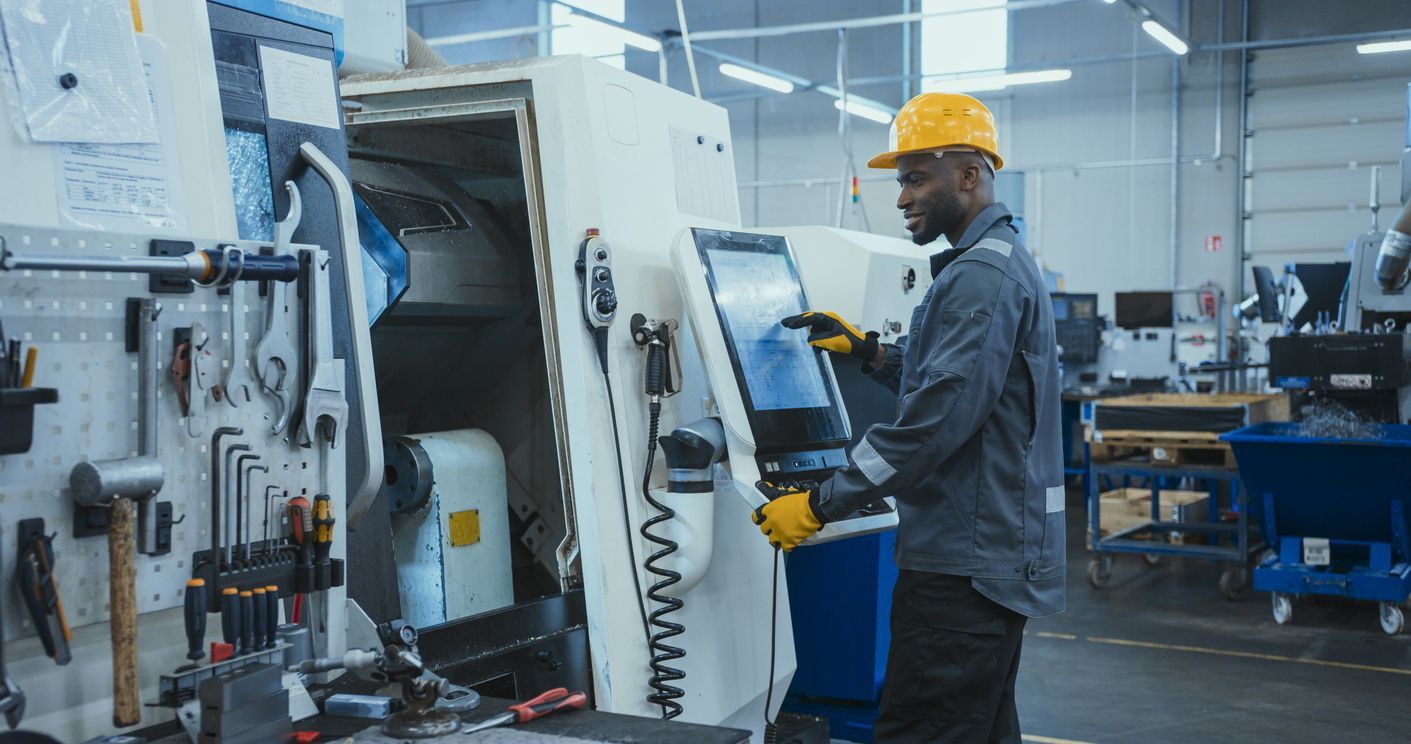
Factory worker in hard hat using laptop, monitoring control panel with screens.
January 5, 2026
Every manufacturing leader has lived this moment: The schedule looks perfect. Orders are slotted. Commitments are made. And then reality shows up. A machine goes down. A key operator calls out. Setup times balloon. One late job cascades into five. Suddenly the plan (built meticulously inside your ERP) falls apart. Not because your team failed, but because the plan was never grounded in reality to begin with.  The Hidden Lie Inside Most ERP Schedules
Woman Working in Modern Factory Setting
August 27, 2025
NetSuite’s Model Context Protocol (MCP), built in partnership with Anthropic, helps users leverage AI
job shop manufacturing
June 20, 2025
Job shop manufacturing is a production method where small batches of 1-100 units of customized or unique products are made to meet specific customer requirements. Unlike mass production, each order typically requires unique setups, specialized processes, and custom routing through the facility. In this comprehensive guide, you'll learn: The complete definition of job shop manufacturing How job shops differ from other manufacturing types Industries that rely on job shop methods Technology solutions that optimize job shop operations When to consider implementing specialized ERP systems What is Job Shop Manufacturing? (Definition) Job shop manufacturing is a production strategy focused on customization over volume . Instead of producing thousands of identical items, job shops create small quantities of unique products tailored to specific customer specifications. Key defining characteristics: Small batch sizes - Typically 1-100 units per order High product variety - Hundreds or thousands of different products Custom specifications - Each order has unique requirements Project-based workflow - Work orders last days to weeks Skilled labor - Requires specialized expertise and flexibility Job Shop is a powerful, fully integrated solution built for custom manufacturers, combining quoting, configuration, production, and fabrication workflows inside NetSuite. Learn more about SuiteDynamics' NetSuite Job Shop for Manufacturing.
A man is holding a box and a woman is looking at a tablet in a warehouse.
By Grace Martin May 27, 2025
Uncover the challenges of data quality affecting DIO accuracy, from ghost inventory to inconsistent formats. Find out how to tackle these issues effectively with a NetSuite ERP.
May 8, 2025
In the world of private equity, creating operational value has become increasingly critical as the market evolves. With exit timelines extending and competition for deals intensifying, PE firms are looking beyond financial engineering to drive returns. One emerging strategy that's gaining traction is the consolidation of NetSuite instances across portfolio companies. The Hidden Challenge of System Fragmentation As PE portfolios grow through acquisition, a common pattern emerges: multiple portfolio companies operating on separate NetSuite instances. While each system may work effectively in isolation, the fragmentation creates significant operational inefficiencies at the portfolio level: Redundant Licensing Costs: Each separate instance requires its own licensing structure , creating unnecessary expenses that directly impact EBITDA. Manual Consolidation Effort: Finance teams spend countless hours extracting, transforming, and manually consolidating data from disparate systems. Inconsistent Processes: Basic business functions are handled differently across portfolio companies, limiting standardization efforts. Limited Portfolio-Wide Visibility: Gaining insight across the entire portfolio requires extensive manual effort, delaying strategic decision-making. Integration Challenges: Onboarding new acquisitions becomes increasingly complex when each company maintains its own environment.
Esusu logo
April 30, 2025
Explore Esusu's partnership with SuiteDynamics to enhance financial processes. Schedule a consultation to see how your business can thrive with NetSuite solutions.
Image of an office worker and a laptop, illustrating the concept of case management setup.
By Brittany Klecker April 30, 2025
Discover how to effectively set up and configure case statuses, rules, types, priorities, and more in NetSuite's case management system. Streamline your workflow and improve customer support with this comprehensive guide.
A man is holding a stack of cardboard boxes in a warehouse.
By Grace Martin April 26, 2025
Backorders disrupt revenue and frustrate customers. Learn what "backordered" means, how backorders happen, their impact on businesses, and how NetSuite ERP can minimize the issues.
More Posts