Case Study: Profectus Livestock Solutions

Nearly every company encounters the unexpected when implementing an ERP. The right implementation partner can make the difference between overcoming those obstacles and failing completely.


Not every enterprise resource planning (ERP) implementation involves entirely new software. Sometimes, the job features an old system for a new company.


Profectus Livestock Solutions (PLS) approached SuiteDynamics in early 2024 to implement and customize a NetSuite ERP platform that could accommodate the former subsidiary’s newly formed organization. The PLS team used NetSuite with their parent company and wanted the business to have its own instance to accommodate unique processes—and they needed that system in 90 days.


Without expert guidance, a company could never implement a complex ERP platform in three months. The staff would create a mess of modules and workflows, wasting time and money. Then, they would still have to contract experts to sort it all out.


We know your time and resources are too valuable to squander. SuiteDynamics works with NetSuite to customize and implement NetSuite ERP software for companies in nearly every industry. Our experts will examine your goals and pain points and produce bespoke software solutions that meet your needs.


Schedule a free consultation with our team to discuss your company’s process issues and how SuiteDynamics can solve them with NetSuite software. We can even visit onsite to assess your operations or ERP system in person. Together, we’ll discover just how well your business can run.


Schedule a Consultation
Graphic with the Profectus Livestock Solutions logo.

The Client:


Established in 2024, PLS is a livestock animal health and feed retailer that provides veterinary services and animal health products to farms throughout the Upper Midwest. The company currently employs 27 staff members and serves more than 1,000 customers.


The Problem:


Until recently, the PLS team operated within the Farmers Business Network's (FBN) livestock subsidiary. During that time, PLS employees conducted business through FBN’s NetSuite ERP system.


Of course, after breaking away from FBN and establishing itself as Profectus Livestock Solutions, the company needed its own NetSuite instance.


However, the ERP implementation wasn’t cut and dry. FBN’s NetSuite platform included a prescription and prescription-adjacent record management system that didn’t transfer to PLS’s new instance. The system was crucial because it allowed PLS to issue and track prescriptions and veterinary visits, ensuring the company only sold prescription products to prescription holders. Without it, the business would have difficulty complying with regulations.


PLS also needed this work done quickly. As business was ramping up, the company requested a quick 90-day implementation and a corrected record management system by June 2024.
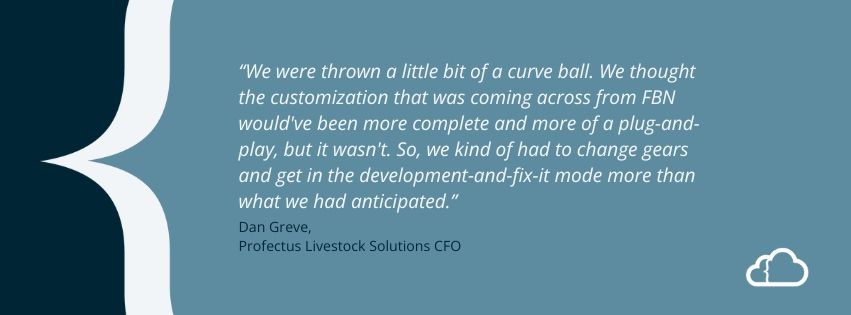
 

Graphic with a quote from PLS CFO Dan Greve about their NetSuite implementation.


The Solution:


PLS chose to work with SuiteDynamics based on a recommendation from NetSuite. CFO Dan Greve said his company appreciated that SuiteDynamics was based in the Midwest and had performed a fair amount of customization before, which would come in handy while building the record management system.


In March 2024, our team began a net new implementation that included Avalara, Bill.com, and Versapay connections. SuiteDynamics experts dedicated more than 750 hours to customizing and configuring sales management systems, serial tracking control, prescription custody and approval processes, a custom commission structure, a custom flight check script, and other solutions for boosting PLS’s performance.


Then, of course, SuiteDynamics addressed the record management problem.


“We were thrown a little bit of a curve ball,” Greve says about the issue. “We thought the customization that was coming across from FBN would've been more complete and more of a plug-and-play, but it wasn't. So, we kind of had to change gears and get in the development-and-fix-it mode more than what we had anticipated.”


SuiteDynamics functional consultants spearheaded “development-and-fix-it mode” by reformatting legacy scripts and custom records to ensure successful transaction processing. This reformatting helped salvage parts of the bundle PLS transferred from FBN’s system so SuiteDynamics didn’t have to rebuild it from scratch. Eventually, the work paid off, and the system could track and manage prescriptions as needed.


After 90 days, the SuiteDynamics team completed a minimum viable product go-live just before the client’s June deadline. 
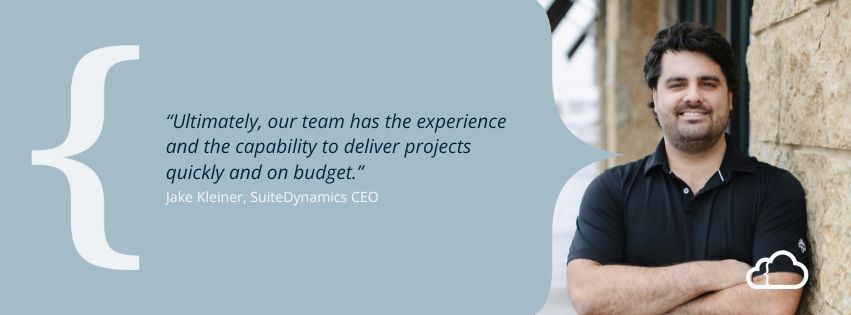
 

Graphic with a quote from Jake Kleiner about the PLS NetSuite implementation.


The Result:


The PLS NetSuite ERP went live on June 3, 2024. Despite first-day glitches, the brand-new company recorded 59 orders and over $100,000 by the close of business. Greve was pleased with the final product.


“I think overall, it's been an improvement for our whole team as far as transactional visibility and access to information quickly and easily,” he says. “I think, especially, our AP component has been streamlined quite a bit. … There's some expense management and credit card reimbursement package that we've got integrated with NetSuite, so all those credit card transactions sync directly to NetSuite. It’s a big time-saver.”


After going live, SuiteDynamics worked with Greve and his team to find the best solution for continuing services. PLS needed additional customizations for its ERP, but it also wanted to keep NetSuite experts on retainer to tackle any issues that might come up during daily operations.


SuiteDynamics prides itself on flexibility, so it devised a hybrid plan for PLS that bundled certain tasks into a Phase 2 contract and tackled others over time using a Managed Service package. The former is a work agreement that concentrates on specific issues. The latter is an arrangement in which the client buys a set number of SuiteDynamics work hours per month for a more fluid list of tasks, like adding customizations, fixing bugs, training users, and addressing problems. The combined approach allowed PLS to get necessary software adjustments while staying within budget.


The Phase 2 project has begun and involves replacing and enhancing the parts of the FBN bundle the SuiteDynamics team couldn’t save. These sections include prescription authorization, sequential prescription numbering, and event record generation features.


SuiteDynamics CEO Jake Kleiner believes his team is particularly suited to this continued work with PLS because of their general ERP expertise and backgrounds in related fields.


“Ultimately, our team has the experience and the capability to deliver projects quickly and on budget,” he says. “We also have deep experience within agriculture as well as vet practices, specifically as it relates to either FDA or other things like controlled substances or regulation around chains of custody with prescriptions and other types of chemicals that are heavily regulated.”


Eventually, the Phase 2 contract will transition into a Managed Service Plan. At that time, the SuiteDynamics team will tackle any unfinished adjustments, such as features covering integrated shipping labels, ISD direction sourcing, and 30-day warnings for prescription, VFD, and VCPR records.


Still, we’re proud of what our experts have accomplished so far. We’re also excited to see how the PLS ERP system continues to evolve and how the company will use it to serve farmers and livestock in the Upper Midwest.


Blow Away the Competition


Stop fighting a software system that's working against you. Instead, enjoy the benefits of an ERP that knits your operations together seamlessly and provides the data and analysis you need to trounce your competition. 


We know you can rise in your industry. 


Team up with SuiteDynamics to develop the ERP system your business needs. As NetSuite Alliance Partners, we customize and implement NetSuite ERP software for clients in any industry. 


Of course, the partnership doesn't stop there. We can work with you long after go-live, maintaining the system, training staff, and adjusting the software to accommodate your expansion. Start by contacting us for your free consultation.


Schedule a Consultation
March 27, 2026
Spreadsheets built modern business. For decades they served as the unofficial operating system of job shops and custom manufacturers everywhere. They are flexible, familiar, and just comfortable enough to feel like a real solution. In the early days of a growing shop, they genuinely work. But as make-to-order complexity increases, as custom BOMs multiply, lead times tighten, and engineering revisions pile up, spreadsheets strain under the pressure. Every job is different, but spreadsheets want everything to be the same. In make-to-order environments, no two jobs are identical. Unique BOMs, custom routings, variable material costs, different setup requirements, customer-specific specs. Spreadsheets, though, thrive on repetition and standardized rows. So the more variation you introduce, the more tabs you create. The more exceptions you add, the more manual overrides appear. The more formulas you patch together, the more fragile the whole thing becomes. Eventually, the file turns into something only one person truly understands. That’s a liability, not a system. Capacity becomes a guessing game. In make-to-order shops, capacity isn’t theoretical. It’s constrained by reality. Machines go down. Operators vary in skill. Setup time fluctuates from job to job. Rush orders blow up carefully planned weeks. Spreadsheets struggle here because they’re built on static inputs. You can build a beautiful planning sheet with machine-hour allocations, but unless it dynamically adjusts for real-time job status, operator availability, overlapping resource conflicts, and maintenance downtime, you’re not really planning. You’re forecasting best-case scenarios. And that’s exactly how shops overpromise delivery dates and end up paying for it later in overtime and expediting costs. Engineering changes don’t cascade cleanly. Change is a constant in make-to-order manufacturing. A customer tweaks a dimension, a material substitution becomes necessary, or a tolerance tightens halfway through production. In an integrated system, that change automatically updates BOMs, routings, cost projections, and scheduling impact all at once. In a spreadsheet environment, it depends entirely on who remembers to update which tab. A routing might change without adjusting the labor estimate. A material substitution might never feed into the margin calculation. A lead-time adjustment might not reach the production schedule until it’s too late. These small disconnects multiply quickly, and because spreadsheets have no enforced relationships between data sets, the errors don’t announce themselves. Institutional knowledge becomes a single point of failure. Ask most growing job shops who owns the master spreadsheet and you’ll get a name. One estimator, planner, or operations manager who has become the living interpreter of years’ worth of embedded formulas, assumptions, and logic that nobody else fully understands. This works fine until it doesn’t. When that person goes on vacation, gets sick, or leaves, the shop loses operational clarity. In an environment already defined by complexity, having critical knowledge live inside one person’s mental model of a file is an inefficient bottleneck. Visibility stops at the file boundary. Spreadsheets are static snapshots. Make-to-order manufacturing is anything but. Without real-time feedback loops, shops find themselves unable to answer questions that should be simple: Are we actually on track this week? Which jobs are consuming more labor than quoted? Where is the bottleneck right now? Which customers consistently drive margin compression? When performance data doesn’t flow automatically from the floor back into quoting and planning, improvement stalls. You can’t refine what you can’t see. Here’s the thing about spreadsheet failure in manufacturing… it’s not dramatic. It’s gradual. First the files get slow, then fragile, then opaque. By the time leadership feels the real pain through late shipments, squeezed margins, and rising overtime, the architectural issues are widespread. Make-to-order manufacturing demands systems that understand relationships: how a routing affects capacity, how a BOM revision affects cost, how a delayed job cascades through the rest of the schedule. The question most shops ask is whether they can make the spreadsheets work. The better question is what it’s actually costing to keep them. The most resilient make-to-order manufacturers are building systems that preserve flexibility without sacrificing the visibility needed to actually run the business. Adaptability is the advantage. 
March 23, 2026
In custom manufacturing , when systems break down, profit rarely disappears all at once. It leaks. Quietly, repeatedly, and often in ways that never show up clearly on any report. Walk into almost any fabrication shop and you’ll hear some version of the same story: the backlog is strong, revenue looks good, we’re staying busy. And yet the margin feels thinner than it should. For job shops running custom work, profitability doesn’t usually collapse because of one bad decision. It erodes through small, daily inefficiencies buried inside quoting, scheduling, engineering changes, and the gap between what was planned and what actually happened on the floor. Here’s where shops most commonly lose efficiency, and how to get it back. The quote that was almost right. For custom orders, every quote is a prediction, and predictions are dangerous when they’re disconnected from real shop-floor data. Outdated labor standards, underestimated setup time, material prices that changed since the template was built, and capacity assumptions based on average weeks instead of current reality. These errors are each small on their own, but a 4% underestimate on labor here, a missed secondary operation there, add up across hundreds of jobs. Small errors compound into real margin loss. The best-performing shops treat quoting as a living system fed by actual job performance data, not static spreadsheets that nobody updates. Capacity that looks available but isn’t. On paper, there’s open space on the schedule. In practice, that open week includes a machine down for maintenance, a senior operator on vacation, two complex jobs already competing for the same bottleneck, and a rush order someone verbally committed to last Thursday. Without finite capacity planning, shops routinely overcommit based on theoretical machine hours rather than real-world constraints. The fallout is predictable: overtime spikes, expedited shipping costs, re-sequencing chaos, and exhausted operators. Margin shrinks not because the shop is incapable, but because it’s planning in averages. Engineering changes that never get repriced. Designs evolve. A hole moves, a weld spec changes, or a tolerance tightens. Each adjustment has a cost. But many shops hesitate to reprice midstream, worried about damaging the customer relationship, and end up absorbing the extra labor and rework time instead. Do this enough times and it becomes a cultural norm: “we’ll just take care of it.” That’s margin erosion disguised as good service. High-performing job shops track engineering change impact in real time and make repricing decisions based on data rather than discomfort. Setup time hiding in plain sight. In low-volume, high-mix environments, setup time is often the silent killer. When shops don’t track setup separately from run time, assume it’ll all come out in the wash, and never refine their routings based on what actually happened, they end up underpricing complexity. In job shops producing one to fifty unit runs, setup can represent a disproportionate share of total labor. If it isn’t measured accurately, it can’t be priced accurately. The spreadsheet layer nobody talks about. Most shops run a hybrid environment where the ERP handles transactions and spreadsheets handle reality. Capacity lives in one file, quoting assumptions in another, and actual job performance in someone’s head. This creates invisible disconnects. Quotes not aligned with current routing, schedules that don’t reflect real constraints, and historical performance that never feeds forward into better decisions. Each disconnect feels manageable in isolation. Collectively, they create margin leakage that leadership can feel but can’t quite locate. What makes all of this so frustrating isn’t that shop owners don’t care. It’s that they can’t see clearly enough to act decisively. Without integrated visibility across quoting, routing, capacity, and quality, operators run on instinct. And instinct works remarkably well until scale and complexity outpace it. The shops that consistently outperform aren’t necessarily the biggest or the busiest. They operate with clarity and consistency. Fewer assumptions and more decisions based on reality. In a manufacturing landscape where lead times keep shrinking and customers expect speed and precision at the same time, margin won’t be protected by effort alone.
January 5, 2026
Every manufacturing leader has lived this moment: The schedule looks perfect. Orders are slotted. Commitments are made. And then reality shows up. A machine goes down. A key operator calls out. Setup times balloon. One late job cascades into five. Suddenly the plan (built meticulously inside your ERP) falls apart. Not because your team failed, but because the plan was never grounded in reality to begin with.  The Hidden Lie Inside Most ERP Schedules
August 27, 2025
NetSuite’s Model Context Protocol (MCP) , built in partnership with Anthropic, helps users leverage AI to ask simple, natural-language questions and get back complex, structured analysis, all powered by live NetSuite data. This practical use of AI can be used to generate reports, create or update records, perform queries, analyze reports, automate workflows, or make predictions based on real-time data. Here's how you can get started and connect AI to NetSuite using MCP: 1. Login to NetSuite and navigate to Customization → SuiteCloud Development → SuiteApp Marketplace. 2. Search “MCP Tools” > Click on the icon and install the MCP Tools SuiteApp
job shop manufacturing
June 20, 2025
Job shop manufacturing is a production method where small batches of 1-100 units of customized or unique products are made to meet specific customer requirements. Unlike mass production, each order typically requires unique setups, specialized processes, and custom routing through the facility. In this comprehensive guide, you'll learn: The complete definition of job shop manufacturing How job shops differ from other manufacturing types Industries that rely on job shop methods Technology solutions that optimize job shop operations When to consider implementing specialized ERP systems What is Job Shop Manufacturing? (Definition) Job shop manufacturing is a production strategy focused on customization over volume . Instead of producing thousands of identical items, job shops create small quantities of unique products tailored to specific customer specifications. Key defining characteristics: Small batch sizes - Typically 1-100 units per order High product variety - Hundreds or thousands of different products Custom specifications - Each order has unique requirements Project-based workflow - Work orders last days to weeks Skilled labor - Requires specialized expertise and flexibility Job Shop is a powerful, fully integrated solution built for custom manufacturers, combining quoting, configuration, production, and fabrication workflows inside NetSuite. Learn more about SuiteDynamics' NetSuite Job Shop for Manufacturing.
A man is holding a box and a woman is looking at a tablet in a warehouse.
By Grace Martin May 27, 2025
Uncover the challenges of data quality affecting DIO accuracy, from ghost inventory to inconsistent formats. Find out how to tackle these issues effectively with a NetSuite ERP.
May 8, 2025
In the world of private equity, creating operational value has become increasingly critical as the market evolves. With exit timelines extending and competition for deals intensifying, PE firms are looking beyond financial engineering to drive returns. One emerging strategy that's gaining traction is the consolidation of NetSuite instances across portfolio companies. The Hidden Challenge of System Fragmentation As PE portfolios grow through acquisition, a common pattern emerges: multiple portfolio companies operating on separate NetSuite instances. While each system may work effectively in isolation, the fragmentation creates significant operational inefficiencies at the portfolio level: Redundant Licensing Costs: Each separate instance requires its own licensing structure , creating unnecessary expenses that directly impact EBITDA. Manual Consolidation Effort: Finance teams spend countless hours extracting, transforming, and manually consolidating data from disparate systems. Inconsistent Processes: Basic business functions are handled differently across portfolio companies, limiting standardization efforts. Limited Portfolio-Wide Visibility: Gaining insight across the entire portfolio requires extensive manual effort, delaying strategic decision-making. Integration Challenges: Onboarding new acquisitions becomes increasingly complex when each company maintains its own environment.
Esusu logo
April 30, 2025
Explore Esusu's partnership with SuiteDynamics to enhance financial processes. Schedule a consultation to see how your business can thrive with NetSuite solutions.
Image of an office worker and a laptop, illustrating the concept of case management setup.
By Brittany Klecker April 30, 2025
Discover how to effectively set up and configure case statuses, rules, types, priorities, and more in NetSuite's case management system. Streamline your workflow and improve customer support with this comprehensive guide.
A man is holding a stack of cardboard boxes in a warehouse.
By Grace Martin April 26, 2025
Backorders disrupt revenue and frustrate customers. Learn what "backordered" means, how backorders happen, their impact on businesses, and how NetSuite ERP can minimize the issues.
More Posts